Tuesday, December 13, 2011

Rubric: For NASA RESEARCH

1. ALL Typed:
2. 2 paragraphs
  • include what they hope to accomplish
  • what is the name of the mission
  • where is the satalite or object located
  • if you can find it how much did it cost
  • other intersting facts
3. include 2 pictures-minimum and explain briefly their significane 
4. cite your sources
5. ask questions
Big Bang Do Now

Do Now:  What do you know about the big bang?


After watching  How the Universe Works - Big Bang, how has your knowledge changed?

http://www.pbs.org/wgbh/nova/universe/historysans.html

Sunday, December 11, 2011

half life lab

http://mjksciteachingideas.com/pdf/HalfLifeLab.pdf

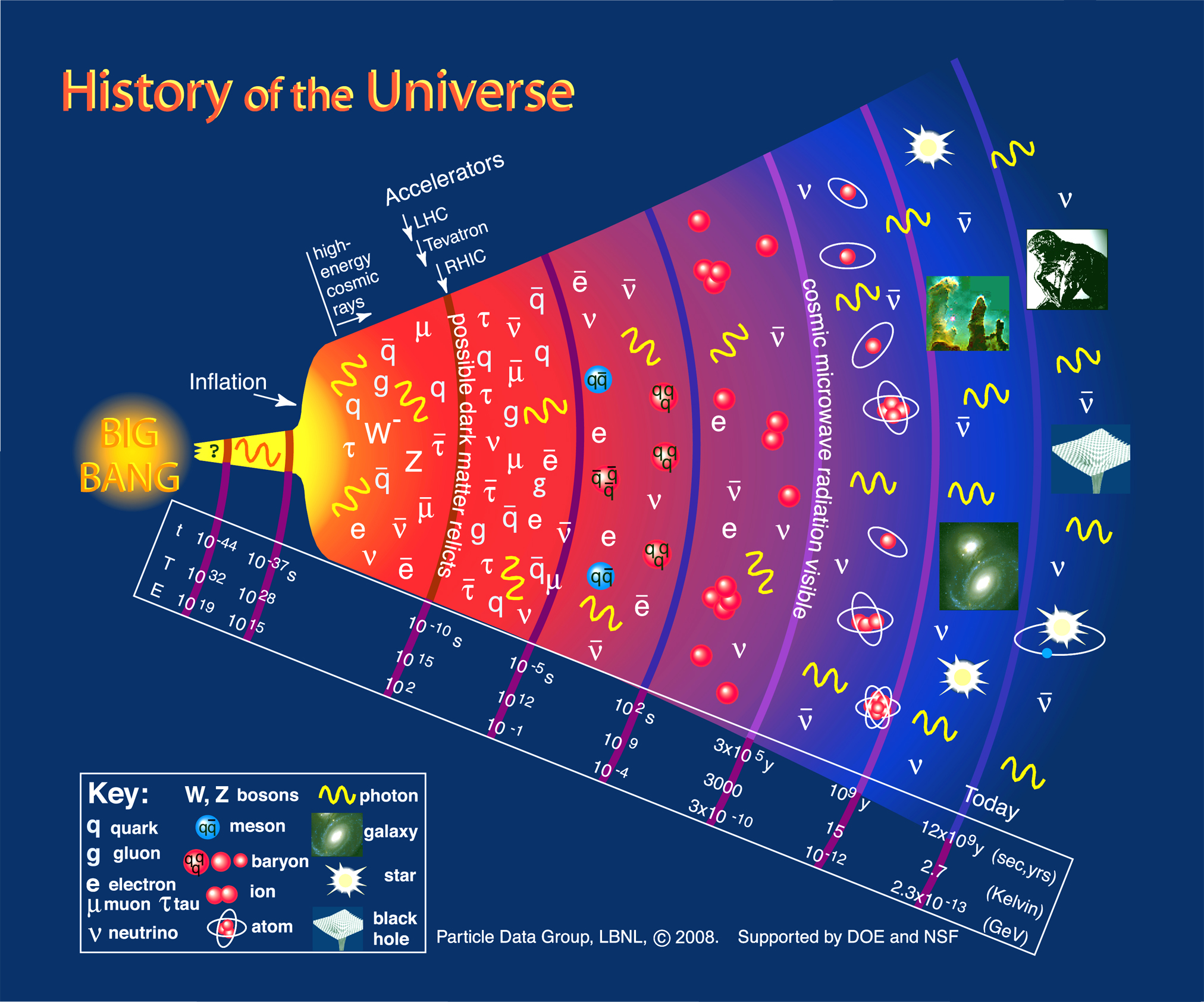
Big Bang: What Happened When.

http://www.pbs.org/wgbh/nova/universe/historywave.html
Great Web Link for The Story of the Big Bang


  • The Planck time: 10-43 seconds. After this time gravity can be considered to be a classical background in which particles and fields evolve following quantum mechanics. A region about 10-33 cm across is homogeneous and isotropic, The temperature is T=1032K.
  • Inflation begins. In Linde's chaotic inflation model inflation starts at the Planck time, although it could start when the temperature falls to point at which the symmetry of Grand Unified Theory (GUT) is spontaneously broken. This occurs when the temperature is around 1027 to 1028K at 10-35 seconds after the Big Bang.
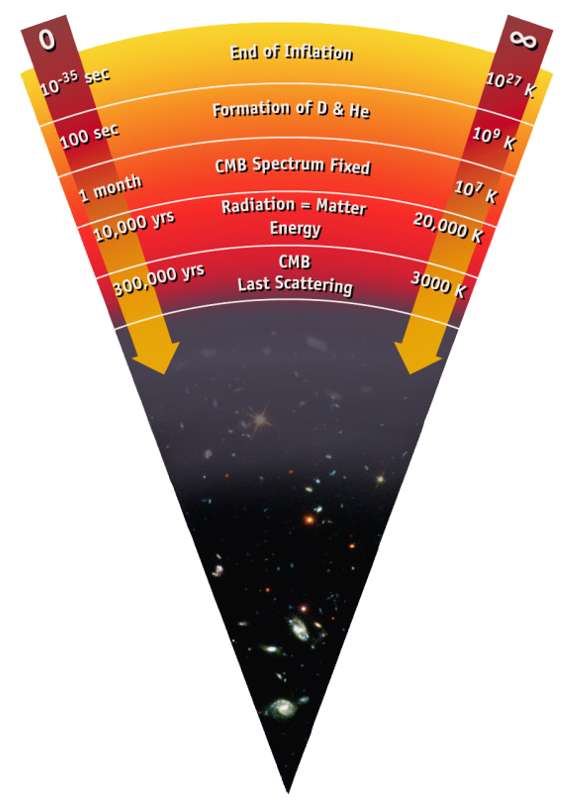
  • Inflation ends. The time is 10-33 seconds, the temperature is again 1027 to 1028K as the vacuum energy density that drove inflation is converted into heat. At the end of inflation the expansion rate is so fast that the apparent age of the Universe [1/H] is only 10-35 seconds. Because of inflation, the homogeneous regions from the Planck time are at least 100 cm across, a growth by a factor greater than 1035 since the Planck time. However, quantum fluctuations during inflation also create a pattern of low amplitude inhomogeneities with a random pattern having equal power on all scales.
  • Baryogenesis: a small difference between the reaction rates for matter and antimatter leads to a mix with about 100,000,001 protons for every 100,000,000 antiprotons (and 100,000,000 photons).
  • Universe grows and cools until 0.0001 seconds after the Big Bang with temperature about T=1013 K. Antiprotons annihilate with protons leaving only matter, but with a very large number of photons per surviving proton and neutron.
  • Universe grows and cools until 1 second after the Big Bang, with temperature T=1010 K. The weak interaction freezes out with a proton/neutron ratio of about 6. The homogeneous patch is now at least 1019.5 cm across.
  • Universe grows and cools until 100 seconds after the Big Bang. The temperature is 1 billion degrees, 109 K. Electrons and positrons annihilate to make more photons, while protons and neutrons combine to make deuterons. Almost all of the deuterons combine to make helium. The final result is about 3/4 hydrogen, 1/4 helium by mass; deuteron/proton ratio 30 parts per million. There are about 2 billion photons per proton or neutron.
  • One month after the Big Bang the processes that convert the radiation field to a blackbody spectrum become slower than the expansion of the Universe, so the spectrum of the Cosmic Microwave Background (CMB) preserves information back to this time.
  • Matter density equals radiation density 56,000 years after the Big Bang. The temperature is 9000 K. Dark matter inhomogeneities can start to collapse.
  • Protons and electrons combine to form neutral hydrogen. Universe becomes transparent. Temperature is T=3000 K, time is 380,000 years after the Big Bang. Ordinary matter can now fall into the dark matter clumps. The CMB travels freely from this time until now, so the CMB anisotropy gives a picture of the Universe at this time.
  • The first stars form 100-200 million years after the Big Bang, and reionize the Universe.
  • The first supernovae explode and spread carbon, nitrogen, oxygen, silicon, magnesium, iron, and so on up through uranium throughout the Universe.
  • Galaxies form as many clumps of dark matter, stars and gas merge together.
  • Clusters of galaxies form.
  • The Solar System and Sun form 4.6 billion years ago.
  • Now: The time is 13.7 Gyr after the Big Bang, and the temperature is T=2.725 K. The homogeneous patch is at least 1029 cm across, which is larger than observable Universe.

Friday, December 9, 2011

A Star is Born

Do Now:  What is the difference between a moon and a planet?  What is the difference between revolution and rotation?

Thursday, December 8, 2011

Balloon Lab

In your lab notebook write down your hypotheses for the following experiment.

After rubbing a balloon against your hair or a paper towel for 30 seconds what will happen


1) if you place the balloon near water?


2) you place the balloon near another balloon?


3) if you place the balloon near a fluorescent light?

4) what works best to charge a balloon?

5) When done go to the computer lab and research what is static electricity.

In your lab notebook record diagrams of your observations.

Tuesday, December 6, 2011

study guide for Chapter 12

study guide for test on Chapter 12 - Monday

-First and foremost understand all the vocabulary.
-use the practice test in the book at the end of the chapter

- understand what causes the type and properties of matter to change is the number of subatomic particles and the way they interact.

Explain what the cathode ray experiment helped prove

Explain what the gold foil experiment helped prove- and explain why the particles went through the gold foil.

What is an electron cloud?

-know how to draw any isotope
examples
C-14
C-15
C-10
etc

- know how to draw any ion
He1+  He2+  He3-  He4-

know how to draw isotope - ion combinations
for example: Oxygen – 15 2+   or Cl – 40 3+


know the size of an atom, size of the nucleus, mass of a proton, mass of a neutron, mass of an electron in scientific notation

d, g period - know scientific notation problems

know what role the strong force plays in radioactive dcecay
know why strong force decreases in usefulness as the size of the nucleus increases

honors: know the difference between alpha, beta and gamma -
honors: describe half-life and its uses
honors: other


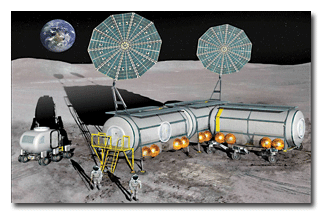
the Moon

Answer one of the following.

Do Now: Would you like to visit the moon, why or why not?

or

Do you believe we will have a lunar colony in your lifetime?  Why or why not?


Friday, December 2, 2011

Do Now:Strong Force:

Do Now #_____ What is the strong force and why don't you think it holds the nucleus of larger atoms together as well as smaller atoms?


This video has a nice explanation of why the strong force can't hold larger atoms together as well as smaller atoms hence causing radioactive elements. Watch from 3:49 seconds on or just watch the whole thing.

Wednesday, November 30, 2011

Half Life - From Wikipedia -

Good Links
Click Here

or here
In general, the half-life of a nuclide depends solely on its nuclear properties; it is not affected by external factors such as temperature, pressure, chemical environment, or presence of a magnetic or electric field.[3][4][5] (For some nuclides which decay by the process of electron capture, such as beryllium-7, strontium-85, and zirconium-89, the decay rate may be slightly affected by local electron density, therefore these isotopes may not be as suitable for radiometric dating.) But in general, the half-life of any nuclide is essentially a constant. Therefore, in any material containing a radioactive nuclide, the proportion of the original nuclide to its decay product(s) changes in a predictable way as the original nuclide decays over time. This predictability allows the relative abundances of related nuclides to be used as a clock to measure the time from the incorporation of the original nuclide(s) into a material to the present.

Tuesday, November 29, 2011

IONS

Do Now# _____ Define Ion and then draw an ion of helium. Clearly label your protons, neutrons and electrons.

Monday, November 28, 2011

Do Now # ___

Define: Atomic number, mass number and isotope and then draw an isotope of Carbon. (Clearly label your protons, neutrons and electrons.)

Thursday, November 17, 2011

Chapter 12 vocabulary

Atoms
Model
Theory
Nucleus
Electrons
Electron cloud
Protons,
atomoic mass unit (amu)
Nuetrons
Atomic number
Isotopes
Mass number
Atomic mass
Forces in atoms
·         Gravity


·         Electromagnetic force


·         Strong force


·         Weak force

Tuesday, November 8, 2011

Vocabulary for quiz on Monday

  • element
  • pure substance
  • metal
  • metaloid
  • nonmetal
  • compound
  • mixture
  • conductor
  • thermal and electrical conductivity
  • malleable
  • ductile
  • brittle
  • law of definite proportions (pg 86)
  • chemical properties
  • physical properties
  • chemical change
  • physical change
this unit assumes a mastery of vocab from previous unit on physical characteristics: density, solubility, conductivity, etc.

List of Blogs

Dear Students,

I would like a link for each of your blogs.  Please comment with the web address of your blog.

Thanks.

Mr. Sneideman

Monday, November 7, 2011


Chemical Hazards

The human race is now polluted with thousands of industrial chemicals - with little or often no understanding of the consequences.  Many times chemicals are recalled after decades of use.  In fact, babies are born with as many as 300 industrial chemicals in their bodies when they enter the world.  Lets learn more as a class so we can be informed citizens and consumers.


Go to this web address and read and explore for 20 minutes.  Come to class with an idea of which category you would like to study.

http://watoxics.org/chemicals-of-concern 

Chemicals of concern specific to children's toys
http://www.healthystuff.org/departments/toys/chemicals.introduction.php


Washington Toxics Coalition - lots of good links.
http://watoxics.org/about

US GOVERNMENT WEBSITE ON WATER POLUTION

http://water.usgs.gov/

Links for Pesticides
plastics 101 –

Teflon and Gore-Tex
http://www.ewg.org/reports/pfcworld

Links to for chemicals and children's health.
http://www.ewg.org/childrenshealth
http://www.healthystuff.org/departments/toys/


Flame Retardants
 http://www.cleanproduction.org/Flame.About.php
 

You might have been looking for…

Washington Toxics Coalition
Toxic-free, organic, Precautionary Principle, Growing Up Green, Earliest Exposures, Chemicals of Concern, Heavy Metals, Lead, Mercury, Pesticide Free Zone, ...
Chemicals of Concern
Chemicals of Concern Header
Your Thyroid on Plastic
Phthalates, which are widely used to make plastic products soft and bendable, have prompted concern among scientists for their adverse human health effects. ...
Toxic-Free Kids Legislation Hits Committees
This week, committees in both the Washington state House and Senate held hearings on the Children’s Safe Products Bill, new legislation to help protect ...
Earliest Exposures
A Research Project by Washington Toxics Coalition. In this study, we investigated the environment experienced by nine fetuses—their mothers. We tested nine ...
Washington State Issues Landmark Rule on Disclosure of Toxic Chemicals in Children’s Products
Under a new rule issued by the Washington state Department of Ecology, makers of children’s products will soon have to report what toxic chemicals are present ...
One in Three Children's Toys Tested Found to Have Significant Levels of Toxic Chemicals
Choosing Safer Products: Toys
Choosing Safer Products: Toys, resources for finding healthy toys.
Consumers Respond With Overwhelming Demand for More Information About Chemicals in Toys
Out Of The Frying Pan, Into The Fire
For many people, the thought of toxic flame retardants quickly brings up one image: toxic chemicals in children’s pajamas. That’s because back in 1977, the ...

Rubric - Chemical Blog Project

Name _______________________   Partner____________________         Blog Grading Sheet


Blog Design Criteria
Evidence
Pts
Comments
   At least 2 pages


Apropriate titles


Have at least 3 entries on main page


Grammatically correct


Includes a link to the class wiki


Embed 2 videos appropriate to the topic


Insert pictures minimum 3


Include a survey question with a date till December 1st 


Remove unnecessary gadgets  - (followers and about me)


You include links to websites that have useful information (minimum 3) and a Link to class blog


Special instructions from Mr. Sneideman


CONTENT
Evidence
Pts
Comments
Why you chose your particular chemical/group


What you learned each day of the project


What is your chemical group used for? Explain how it is applied, created and distributed.


How does your chemical group affect human growth and or development: (What are the effects on human health?)


Is it cancerous (carcinogen)? If so at what level?


How toxic is it?  What is its toxicity?


What steps consumers can take to protect themselves – explain how the steps help…


Where one can go to find info on the safety of chemicals/products with links.


Compound or Element?  How is it made?


Vocab: I want to see (10) science vocab words bolded and defined.  When you encounter words you do not understand, dig deeper!


Thursday, November 3, 2011

Recent Do Now's

Is air a mixture or a compound?  Explain.
Under what process can compounds be seperated?  What is the end result?
How do we know if something is a metal?
How do we know if something is a compound or element?

Tuesday, November 1, 2011

Compounds and Mixtures Do Now # ____

Do Now # ____
Is the air we breathe a compound or mixture?  How can we know?

Monday, October 10, 2011

Additional Vocabulary on Physical Change

  • melting
  • freezing
  • condensation
  • evaporation
  • vaporization
  • sublimation
  • plasmafication
  • Boyle's Law
  • Charles's Law
  • Heat
  • endothermic
  • exothermic
  • freezing point
  • melting pt.
  • condensation pt
  • vaporization pt.
  • CHARACTERISTIC PROPERTY
  • heat
  • temperature

Why does that happen? Do Now # 11

Do Now #11?  Why do our ski goggles or car windshield gets foggy, drinks sweat, ice forms on the outside of our windows when it hasn't rained, and why do clouds form?


http://www.ptable.com/

Wednesday, September 28, 2011

States of Matter Game

Play the game, to practice sorting plasmas.  Let me know your high score. Click HERE

How does temperature and pressure affect the state of matter?  Click Here

Tuesday, September 27, 2011

Bose Einstein Condensate - 0 Degrees Kelvin - Zero Energy

OK Zach, Bend your mind around this. not really the same thing but here is a video about liquid metal that is mind blowing.

Sunday, September 25, 2011

Vocabulary

Do Now #11. What is your best method for learning new vocabulary?