Tuesday, December 13, 2011

Rubric: For NASA RESEARCH

1. ALL Typed:
2. 2 paragraphs
  • include what they hope to accomplish
  • what is the name of the mission
  • where is the satalite or object located
  • if you can find it how much did it cost
  • other intersting facts
3. include 2 pictures-minimum and explain briefly their significane 
4. cite your sources
5. ask questions

Big Bang Do Now

Do Now:  What do you know about the big bang?


After watching  How the Universe Works - Big Bang, how has your knowledge changed?

http://www.pbs.org/wgbh/nova/universe/historysans.html

Sunday, December 11, 2011

half life lab

http://mjksciteachingideas.com/pdf/HalfLifeLab.pdf

Big Bang: What Happened When.

http://www.pbs.org/wgbh/nova/universe/historywave.html
Great Web Link for The Story of the Big Bang


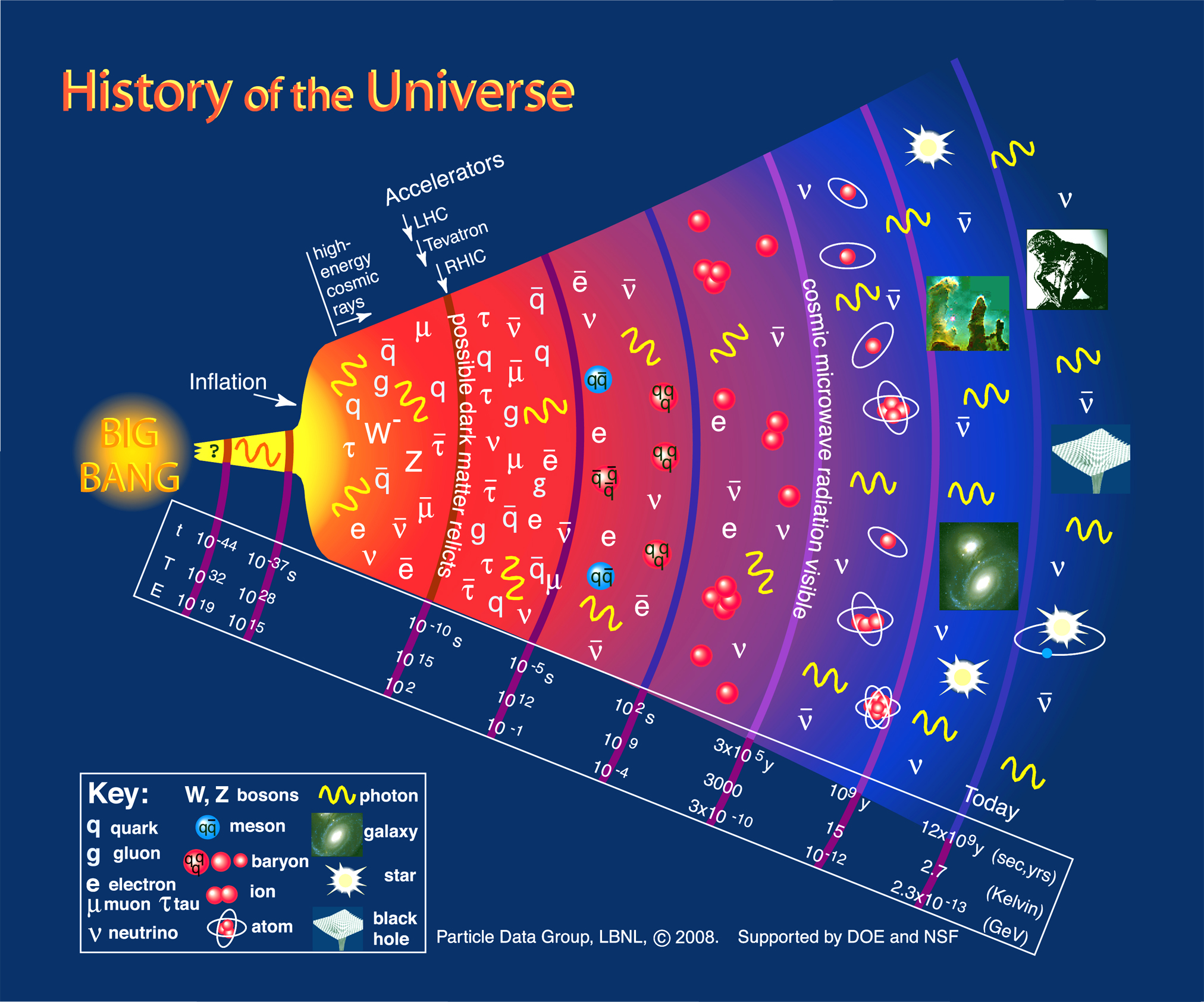
  • The Planck time: 10-43 seconds. After this time gravity can be considered to be a classical background in which particles and fields evolve following quantum mechanics. A region about 10-33 cm across is homogeneous and isotropic, The temperature is T=1032K.
  • Inflation begins. In Linde's chaotic inflation model inflation starts at the Planck time, although it could start when the temperature falls to point at which the symmetry of Grand Unified Theory (GUT) is spontaneously broken. This occurs when the temperature is around 1027 to 1028K at 10-35 seconds after the Big Bang.
  • Inflation ends. The time is 10-33 seconds, the temperature is again 1027 to 1028K as the vacuum energy density that drove inflation is converted into heat. At the end of inflation the expansion rate is so fast that the apparent age of the Universe [1/H] is only 10-35 seconds. Because of inflation, the homogeneous regions from the Planck time are at least 100 cm across, a growth by a factor greater than 1035 since the Planck time. However, quantum fluctuations during inflation also create a pattern of low amplitude inhomogeneities with a random pattern having equal power on all scales.
  • Baryogenesis: a small difference between the reaction rates for matter and antimatter leads to a mix with about 100,000,001 protons for every 100,000,000 antiprotons (and 100,000,000 photons).
  • Universe grows and cools until 0.0001 seconds after the Big Bang with temperature about T=1013 K. Antiprotons annihilate with protons leaving only matter, but with a very large number of photons per surviving proton and neutron.
  • Universe grows and cools until 1 second after the Big Bang, with temperature T=1010 K. The weak interaction freezes out with a proton/neutron ratio of about 6. The homogeneous patch is now at least 1019.5 cm across.
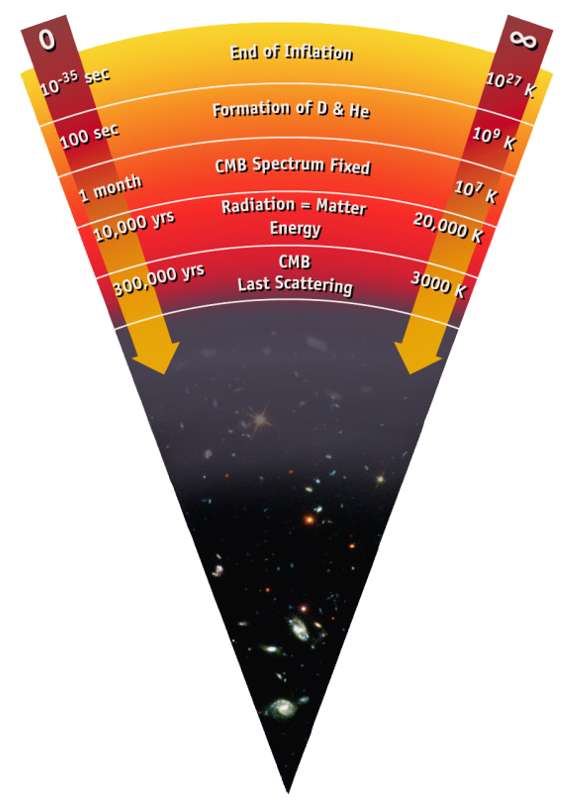
  • Universe grows and cools until 100 seconds after the Big Bang. The temperature is 1 billion degrees, 109 K. Electrons and positrons annihilate to make more photons, while protons and neutrons combine to make deuterons. Almost all of the deuterons combine to make helium. The final result is about 3/4 hydrogen, 1/4 helium by mass; deuteron/proton ratio 30 parts per million. There are about 2 billion photons per proton or neutron.
  • One month after the Big Bang the processes that convert the radiation field to a blackbody spectrum become slower than the expansion of the Universe, so the spectrum of the Cosmic Microwave Background (CMB) preserves information back to this time.
  • Matter density equals radiation density 56,000 years after the Big Bang. The temperature is 9000 K. Dark matter inhomogeneities can start to collapse.
  • Protons and electrons combine to form neutral hydrogen. Universe becomes transparent. Temperature is T=3000 K, time is 380,000 years after the Big Bang. Ordinary matter can now fall into the dark matter clumps. The CMB travels freely from this time until now, so the CMB anisotropy gives a picture of the Universe at this time.
  • The first stars form 100-200 million years after the Big Bang, and reionize the Universe.
  • The first supernovae explode and spread carbon, nitrogen, oxygen, silicon, magnesium, iron, and so on up through uranium throughout the Universe.
  • Galaxies form as many clumps of dark matter, stars and gas merge together.
  • Clusters of galaxies form.
  • The Solar System and Sun form 4.6 billion years ago.
  • Now: The time is 13.7 Gyr after the Big Bang, and the temperature is T=2.725 K. The homogeneous patch is at least 1029 cm across, which is larger than observable Universe.

Friday, December 9, 2011

A Star is Born

Do Now:  What is the difference between a moon and a planet?  What is the difference between revolution and rotation?

Thursday, December 8, 2011

Balloon Lab

In your lab notebook write down your hypotheses for the following experiment.

After rubbing a balloon against your hair or a paper towel for 30 seconds what will happen


1) if you place the balloon near water?


2) you place the balloon near another balloon?


3) if you place the balloon near a fluorescent light?

4) what works best to charge a balloon?

5) When done go to the computer lab and research what is static electricity.

In your lab notebook record diagrams of your observations.

Tuesday, December 6, 2011

study guide for Chapter 12

study guide for test on Chapter 12 - Monday

-First and foremost understand all the vocabulary.
-use the practice test in the book at the end of the chapter

- understand what causes the type and properties of matter to change is the number of subatomic particles and the way they interact.

Explain what the cathode ray experiment helped prove

Explain what the gold foil experiment helped prove- and explain why the particles went through the gold foil.

What is an electron cloud?

-know how to draw any isotope
examples
C-14
C-15
C-10
etc

- know how to draw any ion
He1+  He2+  He3-  He4-

know how to draw isotope - ion combinations
for example: Oxygen – 15 2+   or Cl – 40 3+


know the size of an atom, size of the nucleus, mass of a proton, mass of a neutron, mass of an electron in scientific notation

d, g period - know scientific notation problems

know what role the strong force plays in radioactive dcecay
know why strong force decreases in usefulness as the size of the nucleus increases

honors: know the difference between alpha, beta and gamma -
honors: describe half-life and its uses
honors: other

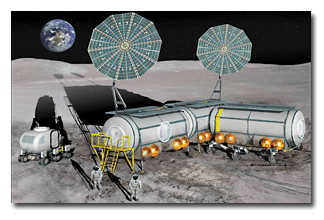
the Moon

Answer one of the following.

Do Now: Would you like to visit the moon, why or why not?

or

Do you believe we will have a lunar colony in your lifetime?  Why or why not?


Friday, December 2, 2011

Do Now:Strong Force:

Do Now #_____ What is the strong force and why don't you think it holds the nucleus of larger atoms together as well as smaller atoms?


This video has a nice explanation of why the strong force can't hold larger atoms together as well as smaller atoms hence causing radioactive elements. Watch from 3:49 seconds on or just watch the whole thing.