Play the game, to practice sorting plasmas. Let me know your high score. Click HERE
How does temperature and pressure affect the state of matter? Click Here
Wednesday, September 28, 2011

Tuesday, September 27, 2011
Bose Einstein Condensate - 0 Degrees Kelvin - Zero Energy
OK Zach, Bend your mind around this.
not really the same thing but here is a video about liquid metal that is mind blowing.
Sunday, September 25, 2011
Vocabulary
Do Now #11. What is your best method for learning new vocabulary?
- solubility
- solute
- solvent
- concentration
- dilute
- dissolve
- solution
- mixture
- chemical property
- physical property
- malleability
- ductility
- funkychicken
- thermal conductivity
- reactivity with
- flammability
- state of matter
- plasma, another plasma link
- define gas
- define liquid
- define solid
- define phase change
- thermal energy
- heat
- temperature
- vaporization
- condensation
- freezing
- melting
- sublimation
Tuesday, September 20, 2011
Do Now #10 - Law of Conservation of Mass
Do Now # 10: What is the law of conservation of mass/matter and does it make sense to you? Why or why not?

1. You have a 20Kg block of wood in a fire. An hour later there is 1 Kg of black ash. What happened to the other 19 Kg?
2. You add 20 gallons of fuel to your car. How much does that mass in Kg? After a week you have only 1 Kg of fuel left in your car, what happened to the other _______Kg?
1 US gallon = 3.78541178 liter and the density of Fuel lets say is .7g/mL
3. Lets imagine a tree absorbing 100 Kg of of CO2 per year. Lets also say it emits 73Kg of oxygen back into the atmosphere. What happened to the other 27%?
4. The U.S. gets about 52% of all its energy for electricity from Coal fired power plants. 1.39 x10 e12 pounds of coal were consumed last year for the production of energy. How much Carbon Dioxide was emitted into the atmosphere?
5.


1. You have a 20Kg block of wood in a fire. An hour later there is 1 Kg of black ash. What happened to the other 19 Kg?
2. You add 20 gallons of fuel to your car. How much does that mass in Kg? After a week you have only 1 Kg of fuel left in your car, what happened to the other _______Kg?
1 US gallon = 3.78541178 liter and the density of Fuel lets say is .7g/mL
3. Lets imagine a tree absorbing 100 Kg of of CO2 per year. Lets also say it emits 73Kg of oxygen back into the atmosphere. What happened to the other 27%?
4. The U.S. gets about 52% of all its energy for electricity from Coal fired power plants. 1.39 x10 e12 pounds of coal were consumed last year for the production of energy. How much Carbon Dioxide was emitted into the atmosphere?
5.
Sunday, September 11, 2011
Hot Air Balloons and the Mass of Air - DO NOW : #9
Do Now # 9 Does Air Have Mass? How do we know?
Hot air balloons are based on a very basic scientific principle: warmer air rises in cooler air. Essentially, hot air is lighter than cool air, because it has less mass per unit of volume. A cubic foot of air weighs roughly 28 grams (about an ounce). If you heat that air by 100 degrees F, it weighs about 7 grams less. Therefore, each cubic foot of air contained in a hot air balloon can lift about 7 grams. That's not much, and this is why hot ir balloons are so huge -- to lift 1,000 pounds, you need about 65,000 cubic feet of hot air.

Mass of Air
1.21kg/m3 at 20 deg C at sea level
1.16kg/m3 at at 30 deg C
Read How Stuff Works For More Info
Air is a mixture of gases and the total mass can be estimated by adding the weight of all major components as shown below:
Hot air balloons are based on a very basic scientific principle: warmer air rises in cooler air. Essentially, hot air is lighter than cool air, because it has less mass per unit of volume. A cubic foot of air weighs roughly 28 grams (about an ounce). If you heat that air by 100 degrees F, it weighs about 7 grams less. Therefore, each cubic foot of air contained in a hot air balloon can lift about 7 grams. That's not much, and this is why hot ir balloons are so huge -- to lift 1,000 pounds, you need about 65,000 cubic feet of hot air.
In simple terms, density is the mass of anything - including air - divided by the volume it occupies. In the metric system, which scientists use, we usually measure density in terms of kilograms per cubic meter. The air's density depends on its temperature, its pressure and how much water vapor is in the air. We'll talk about dry air first, which means we'll be concerned only with temperature and pressure
Mass of Air
1.21kg/m3 at 20 deg C at sea level
1.16kg/m3 at at 30 deg C
Read How Stuff Works For More Info
Components in Dry Air
The two most dominant components in dry air are Oxygen and Nitrogen. Oxygen has a 16 atomic unit mass and Nitrogen has a 14 atomic units mass. Since both of these elements are diatomic in air - O2 and N2, the molecular mass of Oxygen is 32 and the molecular mass of Nitrogen is 28.Air is a mixture of gases and the total mass can be estimated by adding the weight of all major components as shown below:
| Components in Dry Air | Volume Ratio compared to Dry Air | Molecular Mass - M(kg/kmol) | Molecular Mass in Air |
| Oxygen | 0.2095 = 20.95% | 32.00 | 6.704 |
| Nitrogen | 0.7809 = 78.09% | 28.02 | 21.88 |
| Carbon Dioxide | 0.0003= .03% | 44.01 | 0.013 |
| Hydrogen | 0.0000005= etc | 2.02 | 0 |
| Argon | 0.00933 | 39.94 | 0.373 |
| Neon | 0.000018 | 20.18 | 0 |
| Helium | 0.000005 | 4.00 | 0 |
| Krypton | 0.000001 | 83.8 | 0 |
| Xenon | 0.09 10-6 | 131.29 | 0 |
| Total Molecular Mass of Air | 28.97 | ||
Friday, September 9, 2011
Hot Air Balloon Grading Sheet:
Hot Air Balloon Criteria:
Group Name____________________________________ Class Period____
Members in the group________________________________________________
Student Check List
|
Teacher Grade and comment
| |
Hypothesis (if : then statement)
| ||
Renderings / Diagrams/ Designs
| ||
Data tables created
| ||
Data and observations gathered
| ||
Conclusions made
| ||
Discussion of results
(possible errors, possible next steps)
| ||
Creativity of design and neatness
| ||
All completed in Notebook
| ||
Finished on Time
| ||
Teamwork Grade
| ||
Final Report
| ||
Other: (if something comes up I will add it here, don’t forget this is my first time with this lab also so we are learning together)
|
Extra Credit Rubric
Extra Credit Rubric:
You can receive extra credit in 1 of 2 ways.
- Reading any article of scientific interest to you.
- In class when I say I don’t know the answer you get extra credit if you find out.
On a separate sheet of paper answer the following questions.
1. Summarize the findings of your research or the article you chose to read, in one paragraph.
2. Describe any connections with material we are currently learning in class?
3. Discuss the connections to your everyday life (non-classroom) and Explain these connections?
4. List 2 words that you cold learn more about and look them up in a dictionary and then explain how these words are used in the context of this article.
5. Formulate 2 questions about the topic of this article that you still have after reading the entire article.
Thursday, September 8, 2011
Do Now #8 Hot Air Balloon
Do Now # 8
Explain in as much detail as possible how a Hot Air Balloon Floats. Include a discussion of Buoyant Force.
Explain in as much detail as possible how a Hot Air Balloon Floats. Include a discussion of Buoyant Force.
Wednesday, September 7, 2011
Buoyancy - Do Now #7
Do Now # 7
When does the volume of the displaced water = the volume of the object?
When does the mass of the displaced water = the mass of the object?
If an object has a density of 1.1 g/mL what will it do when placed in water?
Why do we float better in salt water?
What is the density of helium compared to the density of atmosphere at sea level? How do you know?
What happens to an ocean liner when all the people get on board?
If an object has a mass of 25 grams and when placed in water floats by only being exactally 1/2 submerged what is the volume of the object and what is the density of the object? What is the buoyant force.
If an object has a volume of 300 cubic centimeters and sinks completely what do you know about its mass? What do you know about the buoyant force?
Better Understanding Buoyant Force. What is a force?
In physics, a force is any influence that causes a object to undergo a change in speed, a change in direction, or a change in shape. Force can also be described by intuitive concepts such as a push or pull that can cause an object with mass to change its velocity (which includes to begin moving from a state of rest), i.e., to accelerate, or which can cause a flexible object to deform. A force has both magnitude and direction, making it a vector quantity. Newton's second law, F=ma, was originally formulated in slightly different, but equivalent terms: the original version states that the net force acting upon an object is equal to the rate at which its momentum changes.[1]
F=MA
Mass time acceleration due to gravity.....
weight is the name given to the force on an object due to gravity. thus:
Weight = mg.
An object with a mass of one kilogram has a weight 9.8 newtons on the surface of the Earth, about one-sixth as much on the Moon, and very nearly zero when in deep space far away from all bodies imparting gravitational influence.
When does the volume of the displaced water = the volume of the object?
When does the mass of the displaced water = the mass of the object?
If an object has a density of 1.1 g/mL what will it do when placed in water?
Why do we float better in salt water?
What is the density of helium compared to the density of atmosphere at sea level? How do you know?
What happens to an ocean liner when all the people get on board?
If an object has a mass of 25 grams and when placed in water floats by only being exactally 1/2 submerged what is the volume of the object and what is the density of the object? What is the buoyant force.
If an object has a volume of 300 cubic centimeters and sinks completely what do you know about its mass? What do you know about the buoyant force?
Better Understanding Buoyant Force. What is a force?
In physics, a force is any influence that causes a object to undergo a change in speed, a change in direction, or a change in shape. Force can also be described by intuitive concepts such as a push or pull that can cause an object with mass to change its velocity (which includes to begin moving from a state of rest), i.e., to accelerate, or which can cause a flexible object to deform. A force has both magnitude and direction, making it a vector quantity. Newton's second law, F=ma, was originally formulated in slightly different, but equivalent terms: the original version states that the net force acting upon an object is equal to the rate at which its momentum changes.[1]
F=MA
Mass time acceleration due to gravity.....
weight is the name given to the force on an object due to gravity. thus:
Weight = mg.
An object with a mass of one kilogram has a weight 9.8 newtons on the surface of the Earth, about one-sixth as much on the Moon, and very nearly zero when in deep space far away from all bodies imparting gravitational influence.
Thursday, September 1, 2011
Do Now #6 - Archimedes Principle
Do Now# 6 - Why do you think an object sinks or floats in water?
In class the other day we should have come to the realization that
1 cm cubed is = 1mL.
This is a 1:1 relationship.
Therefore 100cm cubed is = 100 mL
Honors: What is one meter cubed = ?_____Liters
The reason is this.....a meter cubed is =
100 cm x 100 cm x 100 cm = 1,000,000 cm cubed or 1,000,000 mL
using the King Henry Died by drinking chocolate milk you realize
that is = to 1000 L
Definition of DISPLACEMENT
Buoyant Force
The buoyant force is equal to the weight of the fluid displaced.
When an object weighs less than the total volume of fluid it can displace it will submerge until the point that the buoyant force is equal to the mass of the object. If you were to add more mass to the object it would sink more until reaching equilibrium with its buoyant force.
HONORS: START WATCHING VIDEO AT MINUTE 7
Archimedes Principle:
Science historians generally agree that the idea for his principle occurred to Archimedes as he entered a bath pool. As he waded into deeper water, the force on his feet became less.

Archimedes' Principle is that an object totally or partially immersed in a fluid (liquid or gas) is buoyed (lifted) up by a force equal to the weight of the fluid that is displaced.
Be careful
In class the other day we should have come to the realization that
1 cm cubed is = 1mL.
This is a 1:1 relationship.
Therefore 100cm cubed is = 100 mL
Honors: What is one meter cubed = ?_____Liters
The reason is this.....a meter cubed is =
100 cm x 100 cm x 100 cm = 1,000,000 cm cubed or 1,000,000 mL
using the King Henry Died by drinking chocolate milk you realize
that is = to 1000 L
Definition of DISPLACEMENT
1
: the act or process of displacing : the state of being displaced
2
:the difference between the initial position of something (as a body or geometric figure) and any later position.
Buoyant Force
The buoyant force is equal to the weight of the fluid displaced.
When an object weighs less than the total volume of fluid it can displace it will submerge until the point that the buoyant force is equal to the mass of the object. If you were to add more mass to the object it would sink more until reaching equilibrium with its buoyant force.
HONORS: START WATCHING VIDEO AT MINUTE 7
Archimedes Principle:
Science historians generally agree that the idea for his principle occurred to Archimedes as he entered a bath pool. As he waded into deeper water, the force on his feet became less.
Archimedes' Principle is that an object totally or partially immersed in a fluid (liquid or gas) is buoyed (lifted) up by a force equal to the weight of the fluid that is displaced.
Be careful
Do Now #5 - Finding the density of a regularly shaped object and an irregularly shaped object.
Do Now #5 - Can you give me an example of two objects that have the same volume but different masses? What is true of their densities?
Honors: Today in class you will attempt to discover a method for finding the density of an irregularly shaped object.
But first - in your teams create a data table to find the density of 2 regularly shaped objects. If the object has a regular shape you can use mathematical formulas to discover its density. Include in your lab notes the formulas you are using and the measurements gathered. Ie: your data table needs to include the measurement for your formula prior to beginning.
- A line is one dimensional - cm
- Area is two dimensional 2-D - cm squared
- volume is three dimensional 3-D - cm cubed
- Volume can also be measured in liquids as mL. They don't need to be cubed because Liters implies 3-D

 Once you have finished these two regularly shaped objects see Mr. Sneideman for your irregularly shaped object. You will need to come up with a method to find the volume.....The method for finding the volume of an irregularly shaped object is called the displacement method.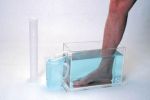
What happens to the water level when you put your foot in the water or say when you get into the bathtub?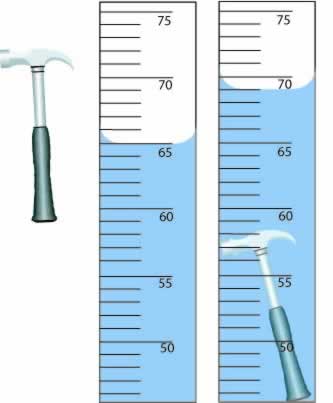
The amount the water rises = the volume of the object in mL. Since 1 mL = 1 cubic cm you can find the volume of the solid object.So you will need to find the volume of your object by dropping the stone into water and measuring how much the level rises. Be Precise.!
Subscribe to:
Posts (Atom)