Friday, December 9, 2011
A Star is Born
Do Now: What is the difference between a moon and a planet? What is the difference between revolution and rotation?

Thursday, December 8, 2011
Balloon Lab
In your lab notebook write down your hypotheses for the following experiment.
After rubbing a balloon against your hair or a paper towel for 30 seconds what will happen
1) if you place the balloon near water?
2) you place the balloon near another balloon?
3) if you place the balloon near a fluorescent light?
4) what works best to charge a balloon?
5) When done go to the computer lab and research what is static electricity.
In your lab notebook record diagrams of your observations.
Wednesday, December 7, 2011
Honors: Quarks
Do Now_________
IF elements are made of atoms and atoms are made from protons, neutrons and electrons then what are protons, neutrons and electons made from?
Click for answer.
The Standard Model


IF elements are made of atoms and atoms are made from protons, neutrons and electrons then what are protons, neutrons and electons made from?
Click for answer.
The Standard Model
Tuesday, December 6, 2011
study guide for Chapter 12
study guide for test on Chapter 12 - Monday
-First and foremost understand all the vocabulary.
-use the practice test in the book at the end of the chapter
- understand what causes the type and properties of matter to change is the number of subatomic particles and the way they interact.
Explain what the cathode ray experiment helped prove
Explain what the gold foil experiment helped prove- and explain why the particles went through the gold foil.
What is an electron cloud?
-know how to draw any isotope
examples
C-14
C-15
C-10
etc
- know how to draw any ion
He1+ He2+ He3- He4-
know how to draw isotope - ion combinations
for example: Oxygen – 15 2+ or Cl – 40 3+
know the size of an atom, size of the nucleus, mass of a proton, mass of a neutron, mass of an electron in scientific notation
d, g period - know scientific notation problems
know what role the strong force plays in radioactive dcecay
know why strong force decreases in usefulness as the size of the nucleus increases
honors: know the difference between alpha, beta and gamma -
honors: describe half-life and its uses
honors: other
the Moon
Answer one of the following.
Do Now: Would you like to visit the moon, why or why not?
or
Do you believe we will have a lunar colony in your lifetime? Why or why not?


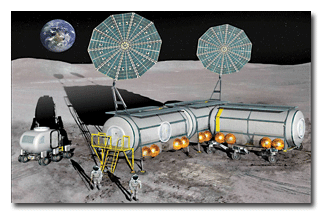

Do Now: Would you like to visit the moon, why or why not?
or
Do you believe we will have a lunar colony in your lifetime? Why or why not?
Friday, December 2, 2011
Do Now:Strong Force:
Do Now #_____ What is the strong force and why don't you think it holds the nucleus of larger atoms together as well as smaller atoms?
This video has a nice explanation of why the strong force can't hold larger atoms together as well as smaller atoms hence causing radioactive elements. Watch from 3:49 seconds on or just watch the whole thing.
This video has a nice explanation of why the strong force can't hold larger atoms together as well as smaller atoms hence causing radioactive elements. Watch from 3:49 seconds on or just watch the whole thing.
Wednesday, November 30, 2011
Half Life - From Wikipedia -
Good Links
Click Here
or here
In general, the half-life of a nuclide depends solely on its nuclear properties; it is not affected by external factors such as temperature, pressure, chemical environment, or presence of a magnetic or electric field.[3][4][5] (For some nuclides which decay by the process of electron capture, such as beryllium-7, strontium-85, and zirconium-89, the decay rate may be slightly affected by local electron density, therefore these isotopes may not be as suitable for radiometric dating.) But in general, the half-life of any nuclide is essentially a constant. Therefore, in any material containing a radioactive nuclide, the proportion of the original nuclide to its decay product(s) changes in a predictable way as the original nuclide decays over time. This predictability allows the relative abundances of related nuclides to be used as a clock to measure the time from the incorporation of the original nuclide(s) into a material to the present.
Subscribe to:
Posts (Atom)