Wednesday, January 4, 2012

MOONKAM Mission Page for non members.
http://www.nasa.gov/mission_pages/grail/overview/index.html
 Artist's concept of the GRAIL mission. Image credit: NASA/JPL-Caltech
The GRAIL mission will place two spacecraft into the same orbit around the Moon. As they fly over areas of greater and lesser gravity, caused both by visible features such as mountains and craters and by masses hidden beneath the lunar surface, they will move slightly toward and away from each other. An instrument aboard each spacecraft will measure the changes in their relative velocity very precisely, and scientists will translate this information into a high-resolution map of the Moon's gravitational field.
This gravity-measuring technique is essentially the same as that of the Gravity Recovery And Climate Experiment (GRACE), which has been mapping Earth's gravity since 2002.
Objectives
GRAIL's engineering objectives are to enable the science objectives of mapping lunar gravity and using that information to increase understanding of the Moon's interior and thermal history. Getting the two spacecraft where they need to be, when they need to be there, requires an extremely challenging set of maneuvers never before carried out in solar system exploration missions. Mission design
The two GRAIL spacecraft will be launched together and then will fly similar but separate trajectories to the Moon after separation from the launch vehicle, taking about 3 to 4 months to get there. They will spend about 2 months reshaping and merging their orbits until one spacecraft is following the other in the same low-altitude, near-circular, near-polar orbit, and they begin formation-flying. The next 82 days will constitute the science phase, during which the spacecraft will map the Moon's gravitational field.
Spacecraft and payload
The two GRAIL spacecraft are near-twins, each about the size of a washing machine, with minor differences resulting from the need for one specific spacecraft (GRAIL-A) to follow the other (GRAIL-B) as they circle the Moon.
The science payload on each spacecraft is the Lunar Gravity Ranging System, which will measure changes in the distance between the two spacecraft down to a few microns -- about the diameter of a red blood cell. Each spacecraft will also carry a set of cameras for MoonKAM, marking the first time a NASA planetary mission has carried instruments expressly for an education and public outreach project.
Mission Overview
Artist's concept of the GRAIL mission. Image credit: NASA/JPL-Caltech The GRAIL mission will place two spacecraft into the same orbit around the Moon. As they fly over areas of greater and lesser gravity, caused both by visible features such as mountains and craters and by masses hidden beneath the lunar surface, they will move slightly toward and away from each other. An instrument aboard each spacecraft will measure the changes in their relative velocity very precisely, and scientists will translate this information into a high-resolution map of the Moon's gravitational field.
This gravity-measuring technique is essentially the same as that of the Gravity Recovery And Climate Experiment (GRACE), which has been mapping Earth's gravity since 2002.
Objectives
GRAIL's engineering objectives are to enable the science objectives of mapping lunar gravity and using that information to increase understanding of the Moon's interior and thermal history. Getting the two spacecraft where they need to be, when they need to be there, requires an extremely challenging set of maneuvers never before carried out in solar system exploration missions. Mission design
The two GRAIL spacecraft will be launched together and then will fly similar but separate trajectories to the Moon after separation from the launch vehicle, taking about 3 to 4 months to get there. They will spend about 2 months reshaping and merging their orbits until one spacecraft is following the other in the same low-altitude, near-circular, near-polar orbit, and they begin formation-flying. The next 82 days will constitute the science phase, during which the spacecraft will map the Moon's gravitational field.
Spacecraft and payload
The two GRAIL spacecraft are near-twins, each about the size of a washing machine, with minor differences resulting from the need for one specific spacecraft (GRAIL-A) to follow the other (GRAIL-B) as they circle the Moon.
The science payload on each spacecraft is the Lunar Gravity Ranging System, which will measure changes in the distance between the two spacecraft down to a few microns -- about the diameter of a red blood cell. Each spacecraft will also carry a set of cameras for MoonKAM, marking the first time a NASA planetary mission has carried instruments expressly for an education and public outreach project.
Sunday, January 1, 2012
The Largest Black Holes
Great Video, Thanks to Tyler B. There is also a series of more videos that are really good.
Check it out.
Check it out.
Tuesday, December 13, 2011
Rubric: For NASA RESEARCH
1. ALL Typed:
2. 2 paragraphs
4. cite your sources
5. ask questions
2. 2 paragraphs
- include what they hope to accomplish
- what is the name of the mission
- where is the satalite or object located
- if you can find it how much did it cost
- other intersting facts
4. cite your sources
5. ask questions
Big Bang Do Now
Do Now: What do you know about the big bang?
After watching How the Universe Works - Big Bang, how has your knowledge changed?
http://www.pbs.org/wgbh/nova/universe/historysans.html
After watching How the Universe Works - Big Bang, how has your knowledge changed?
http://www.pbs.org/wgbh/nova/universe/historysans.html
Sunday, December 11, 2011
Big Bang: What Happened When.
http://www.pbs.org/wgbh/nova/universe/historywave.html
Great Web Link for The Story of the Big Bang
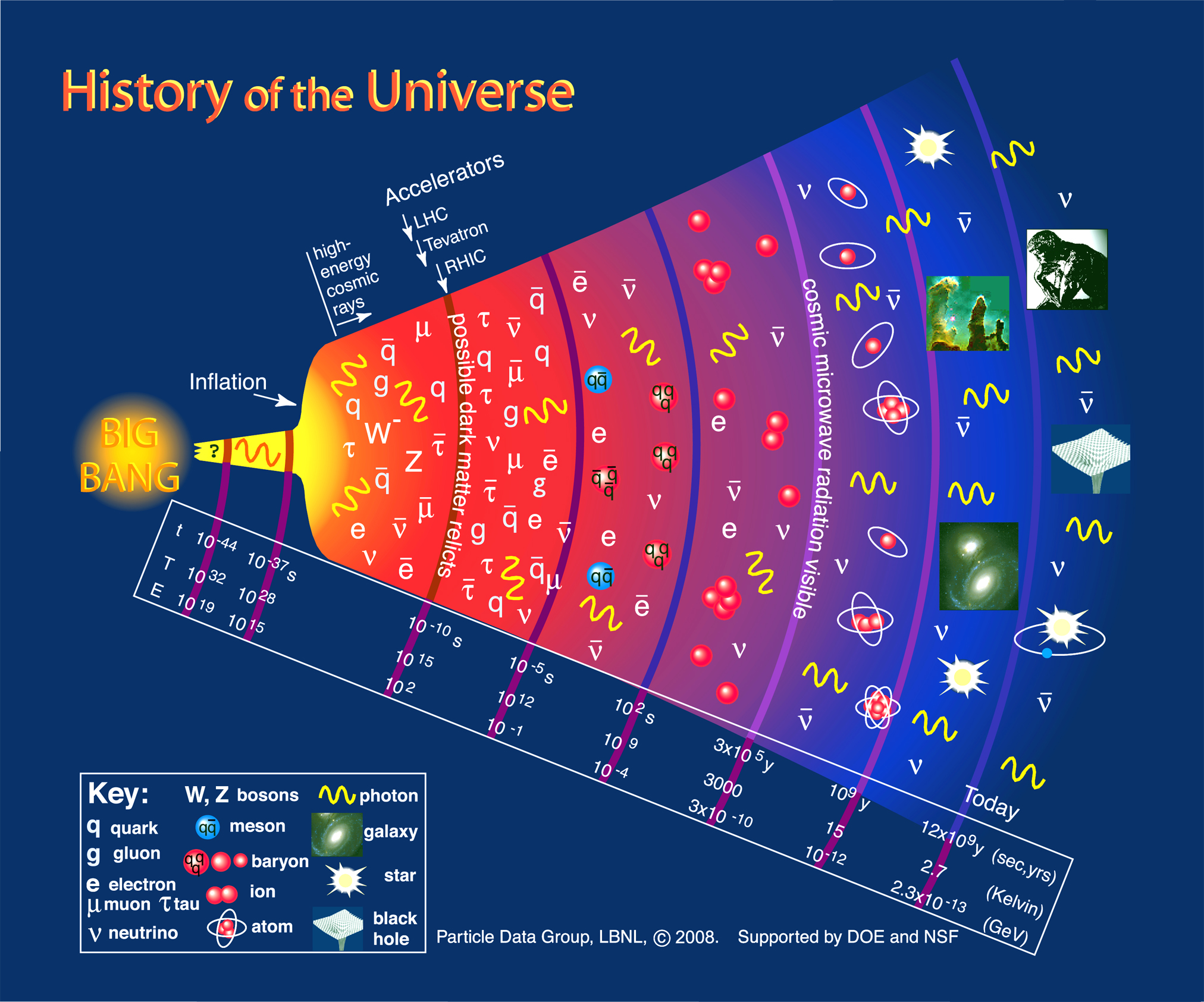
Great Web Link for The Story of the Big Bang
- The Planck time: 10-43 seconds. After this time gravity can be considered to be a classical background in which particles and fields evolve following quantum mechanics. A region about 10-33 cm across is homogeneous and isotropic, The temperature is T=1032K.
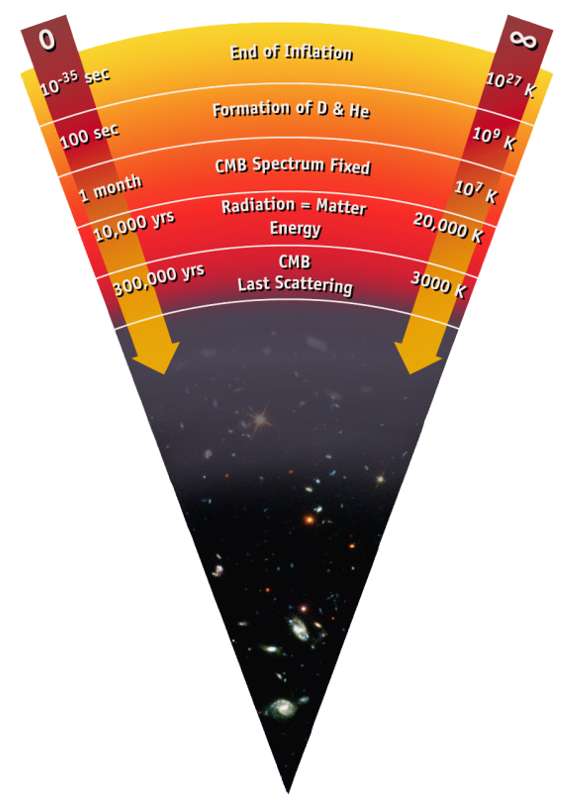
- Inflation begins. In Linde's chaotic inflation model inflation starts at the Planck time, although it could start when the temperature falls to point at which the symmetry of Grand Unified Theory (GUT) is spontaneously broken. This occurs when the temperature is around 1027 to 1028K at 10-35 seconds after the Big Bang.
- Inflation ends. The time is 10-33 seconds, the temperature is again 1027 to 1028K as the vacuum energy density that drove inflation is converted into heat. At the end of inflation the expansion rate is so fast that the apparent age of the Universe [1/H] is only 10-35 seconds. Because of inflation, the homogeneous regions from the Planck time are at least 100 cm across, a growth by a factor greater than 1035 since the Planck time. However, quantum fluctuations during inflation also create a pattern of low amplitude inhomogeneities with a random pattern having equal power on all scales.
- Baryogenesis: a small difference between the reaction rates for matter and antimatter leads to a mix with about 100,000,001 protons for every 100,000,000 antiprotons (and 100,000,000 photons).
- Universe grows and cools until 0.0001 seconds after the Big Bang with temperature about T=1013 K. Antiprotons annihilate with protons leaving only matter, but with a very large number of photons per surviving proton and neutron.
- Universe grows and cools until 1 second after the Big Bang, with temperature T=1010 K. The weak interaction freezes out with a proton/neutron ratio of about 6. The homogeneous patch is now at least 1019.5 cm across.
- Universe grows and cools until 100 seconds after the Big Bang. The temperature is 1 billion degrees, 109 K. Electrons and positrons annihilate to make more photons, while protons and neutrons combine to make deuterons. Almost all of the deuterons combine to make helium. The final result is about 3/4 hydrogen, 1/4 helium by mass; deuteron/proton ratio 30 parts per million. There are about 2 billion photons per proton or neutron.
- One month after the Big Bang the processes that convert the radiation field to a blackbody spectrum become slower than the expansion of the Universe, so the spectrum of the Cosmic Microwave Background (CMB) preserves information back to this time.
- Matter density equals radiation density 56,000 years after the Big Bang. The temperature is 9000 K. Dark matter inhomogeneities can start to collapse.
- Protons and electrons combine to form neutral hydrogen. Universe becomes transparent. Temperature is T=3000 K, time is 380,000 years after the Big Bang. Ordinary matter can now fall into the dark matter clumps. The CMB travels freely from this time until now, so the CMB anisotropy gives a picture of the Universe at this time.
- The first stars form 100-200 million years after the Big Bang, and reionize the Universe.
- The first supernovae explode and spread carbon, nitrogen, oxygen, silicon, magnesium, iron, and so on up through uranium throughout the Universe.
- Galaxies form as many clumps of dark matter, stars and gas merge together.
- Clusters of galaxies form.
- The Solar System and Sun form 4.6 billion years ago.
- Now: The time is 13.7 Gyr after the Big Bang, and the temperature is T=2.725 K. The homogeneous patch is at least 1029 cm across, which is larger than observable Universe.
Subscribe to:
Posts (Atom)