Tuesday, April 24, 2012

Monday, April 23, 2012
Saturday, April 21, 2012
Friday, April 13, 2012
MOONKAM
Happy Vacationing Students,
Our first images of the moon are coming back. If you need more codes let me know at jsneideman@tarbut.com


h
ttp://images.moonkam.ucsd.edu/v/MK12_03/1177_0T840TA600000_37886_2012-088-21_13_42_000_2012-088-21_13_58_508.bmp.html
Our first images of the moon are coming back. If you need more codes let me know at jsneideman@tarbut.com
| Photo ID | 52673 |
| School | tarbutv1 |
| Time Taken (UTC) | 2012/096/11:38:13 |
| Orbit | 1274 |
| Spacecraft | Ebb |
| Camera Direction | Backward |
| Lens (mm) | 6.00 |
| Altitude (km) | 48 |
| Frame Width (km) | 0.00 |
| Frame Height (km) | 48.23 |
| Nadir | 61.54° S, 61.71° W |
| Center | 58.5° S, 62.89° W |
h

ttp://images.moonkam.ucsd.edu/v/MK12_03/1177_0T840TA600000_37886_2012-088-21_13_42_000_2012-088-21_13_58_508.bmp.html
Thursday, March 8, 2012
Rubric for Rover Project
Awards for
- Fastest Acceleration (3 trials average)
- Furthest Distance Traveled (3 trials average)
- Top Average Speed (3 trials average)
- Vote for Best Design
8th grade NASA ROVER DESIGN CHALLENGE RUBRIC
PHASE I. DESIGN PHASE | Pts | CRITERIA | ||||
Mission statements | 20 | · Statement of purpose · Goals of mission are clear and accurate · List and explanation of scientific instruments to be used | ||||
Work log /Blog** | 20 | You keep track of your daily accomplishments, learning, and individual work done – signed off by team leader and/or teacher (photo log on team blog is evidence of work done) | ||||
Design of rover | 30 | · List of materials included · 3 views of your design (top, side, oblique) · Labeled parts · Design includes logo · Includes scientific instruments · TO SCALE** | ||||
Slogan/Logo | 20 | · Creative, appropriate, relevant, colorful and DIGITAL – · Included on your blog · Theme song ** | ||||
Kindergarten Project 1 | 20 | · You have something prepared for your kindergarten team members to work on when you present the topic. (coloring which will be included on the final project) | ||||
PHASE II. BUILDING PHASE | ||||||
Building (daily grade) | 20 | Points will be taken off of the entire team members are idle. Needs to be evidence of progress daily. | ||||
Finished design resembles design | 20 | The percent similarity of your prebuilding design and your finished project. | ||||
Finished project | 50 | · Solidly built – not falling apart · creativity · Moves down a hill by the force of gravity and or with a push · | ||||
Presentation to the board | 50 | · 3-5 minute presentation · Clearly demonstrates knowledge about | ||||
Kindergarten Project 2 | 20 | TBA | ||||
PHASE III. EXPERIMENTING PHASE | |||
Newton’s Law Lab | 50 | TBA | |
Lab Report | 50 | Complete lab report : Includes all sections from lab rubric | |
Finished **Blog of Progress | 50 | TBD | |
Kindergarten Project 3 | 20 | Presentation | |
Other | |||
Tuesday, February 14, 2012
Study Guide Chapter 19
Study Guide Test on Chapter 19.
Understand the phases of the moon.
Understand the H-R diagram
Understand the temp/color/composition of stars
Understand the difference between galaxy types
Understand the big dipper is like a clock and how to read that clock.
Know how to use a star tracker.
Explain the life cycle of a star depending on its starting mass.
Know galaxy worksheet - basics of galaxies and black holes and super galaxies
Understand the meaning of each variable in the Drake equation. F sub capital L?
Essay: Explain the cuases of the seasons in detail. Give examples using the Poles and Tropic Lines.
Essay: Explain the cuases of the seasons in detail. Give examples using the Poles and Tropic Lines.
Spectrum Apparent magnitude Absolute magnitude Light-year Parallax H-R diagram Main sequence White dwarf Red giant Supernova Neutron star Pulsar Black hole Galaxy Spiral galaxy Elliptical galaxy Irregular galaxy Nebula Open cluster Globular cluster Quasar Gibbous Crescent Waxing Waning Solstice Equinox Aphelion Perihelion Angular Heigth of the Sun |
Honors:
· Math using speed of light and scientific notatio
· Math calculating the distance and time to travel to certain stars or size and distance between galaxies calculated.
· Use the Drake equation given certain variables
· What is Dark Matter and Dark Energy?
Do Now: Stars Spectra
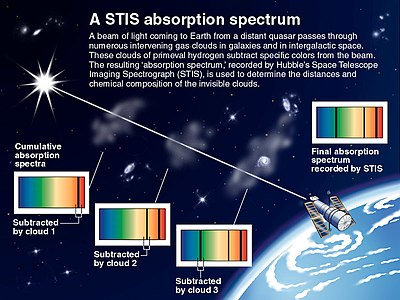
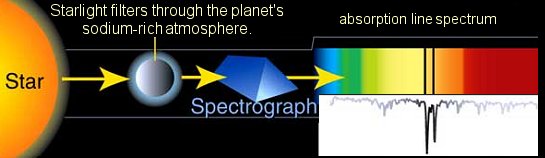
What does the surface color of a star tell us? Explain in detail. Then explain what is an absorption spectra.
Sources of continuous, emission, and absorption spectra
http://csep10.phys.utk.edu/astr162/lect/light/absorption.html
Thus, emission spectra are produced by thin gases in which the atoms do not experience many collisions (because of the low density). The emission lines correspond to photons of discrete energies that are emitted when excited atomic states in the gas make transitions back to lower-lying levels.
A continuum spectrum results when the gas pressures are higher. Generally, solids, liquids, or dense gases emit light at all wavelengths when heated.
An absorption spectrum occurs when light passes through a cold, dilute gas and atoms in the gas absorb at characteristic frequencies; since the re-emitted light is unlikely to be emitted in the same direction as the absorbed photon, this gives rise to dark lines (absence of light) in the spectrum.

Sources of continuous, emission, and absorption spectra
 |
| Sources of continuous, emission, and absorption spectra |
http://csep10.phys.utk.edu/astr162/lect/light/absorption.html
Thus, emission spectra are produced by thin gases in which the atoms do not experience many collisions (because of the low density). The emission lines correspond to photons of discrete energies that are emitted when excited atomic states in the gas make transitions back to lower-lying levels.
A continuum spectrum results when the gas pressures are higher. Generally, solids, liquids, or dense gases emit light at all wavelengths when heated.
An absorption spectrum occurs when light passes through a cold, dilute gas and atoms in the gas absorb at characteristic frequencies; since the re-emitted light is unlikely to be emitted in the same direction as the absorbed photon, this gives rise to dark lines (absence of light) in the spectrum.
Subscribe to:
Posts (Atom)