- A line is one dimensional - cm
- Area is two dimensional 2-D - cm squared
- volume is three dimensional 3-D - cm cubed
- Volume can also be measured in liquids as mL. They don't need to be cubed because Liters implies 3-D

 Once you have finished these two regularly shaped objects see Mr. Sneideman for your irregularly shaped object. You will need to come up with a method to find the volume.....The method for finding the volume of an irregularly shaped object is called the displacement method.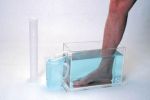
What happens to the water level when you put your foot in the water or say when you get into the bathtub?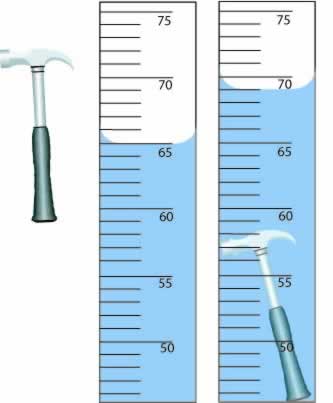
The amount the water rises = the volume of the object in mL. Since 1 mL = 1 cubic cm you can find the volume of the solid object.So you will need to find the volume of your object by dropping the stone into water and measuring how much the level rises. Be Precise.!
Thursday, September 1, 2011
Do Now #5 - Finding the density of a regularly shaped object and an irregularly shaped object.
Do Now #5 - Can you give me an example of two objects that have the same volume but different masses? What is true of their densities?
Honors: Today in class you will attempt to discover a method for finding the density of an irregularly shaped object.
But first - in your teams create a data table to find the density of 2 regularly shaped objects. If the object has a regular shape you can use mathematical formulas to discover its density. Include in your lab notes the formulas you are using and the measurements gathered. Ie: your data table needs to include the measurement for your formula prior to beginning.

Subscribe to:
Post Comments (Atom)
No comments:
Post a Comment
Note: Only a member of this blog may post a comment.