Do Now # 8
Explain in as much detail as possible how a Hot Air Balloon Floats. Include a discussion of Buoyant Force.
Thursday, September 8, 2011

Wednesday, September 7, 2011
Buoyancy - Do Now #7
Do Now # 7
When does the volume of the displaced water = the volume of the object?
When does the mass of the displaced water = the mass of the object?
If an object has a density of 1.1 g/mL what will it do when placed in water?
Why do we float better in salt water?
What is the density of helium compared to the density of atmosphere at sea level? How do you know?
What happens to an ocean liner when all the people get on board?
If an object has a mass of 25 grams and when placed in water floats by only being exactally 1/2 submerged what is the volume of the object and what is the density of the object? What is the buoyant force.
If an object has a volume of 300 cubic centimeters and sinks completely what do you know about its mass? What do you know about the buoyant force?
Better Understanding Buoyant Force. What is a force?
In physics, a force is any influence that causes a object to undergo a change in speed, a change in direction, or a change in shape. Force can also be described by intuitive concepts such as a push or pull that can cause an object with mass to change its velocity (which includes to begin moving from a state of rest), i.e., to accelerate, or which can cause a flexible object to deform. A force has both magnitude and direction, making it a vector quantity. Newton's second law, F=ma, was originally formulated in slightly different, but equivalent terms: the original version states that the net force acting upon an object is equal to the rate at which its momentum changes.[1]
F=MA
Mass time acceleration due to gravity.....
weight is the name given to the force on an object due to gravity. thus:
Weight = mg.
An object with a mass of one kilogram has a weight 9.8 newtons on the surface of the Earth, about one-sixth as much on the Moon, and very nearly zero when in deep space far away from all bodies imparting gravitational influence.
Thursday, September 1, 2011
Do Now #6 - Archimedes Principle
Do Now# 6 - Why do you think an object sinks or floats in water?
In class the other day we should have come to the realization that
1 cm cubed is = 1mL.
This is a 1:1 relationship.
Therefore 100cm cubed is = 100 mL
Honors: What is one meter cubed = ?_____Liters
The reason is this.....a meter cubed is =
100 cm x 100 cm x 100 cm = 1,000,000 cm cubed or 1,000,000 mL
using the King Henry Died by drinking chocolate milk you realize
that is = to 1000 L
Definition of DISPLACEMENT
Buoyant Force
The buoyant force is equal to the weight of the fluid displaced.
When an object weighs less than the total volume of fluid it can displace it will submerge until the point that the buoyant force is equal to the mass of the object. If you were to add more mass to the object it would sink more until reaching equilibrium with its buoyant force.
HONORS: START WATCHING VIDEO AT MINUTE 7
Archimedes Principle:
Science historians generally agree that the idea for his principle occurred to Archimedes as he entered a bath pool. As he waded into deeper water, the force on his feet became less.

Archimedes' Principle is that an object totally or partially immersed in a fluid (liquid or gas) is buoyed (lifted) up by a force equal to the weight of the fluid that is displaced.
Be careful
In class the other day we should have come to the realization that
1 cm cubed is = 1mL.
This is a 1:1 relationship.
Therefore 100cm cubed is = 100 mL
Honors: What is one meter cubed = ?_____Liters
The reason is this.....a meter cubed is =
100 cm x 100 cm x 100 cm = 1,000,000 cm cubed or 1,000,000 mL
using the King Henry Died by drinking chocolate milk you realize
that is = to 1000 L
Definition of DISPLACEMENT
1
: the act or process of displacing : the state of being displaced
2
:the difference between the initial position of something (as a body or geometric figure) and any later position.
Buoyant Force
The buoyant force is equal to the weight of the fluid displaced.
When an object weighs less than the total volume of fluid it can displace it will submerge until the point that the buoyant force is equal to the mass of the object. If you were to add more mass to the object it would sink more until reaching equilibrium with its buoyant force.
HONORS: START WATCHING VIDEO AT MINUTE 7
Archimedes Principle:
Science historians generally agree that the idea for his principle occurred to Archimedes as he entered a bath pool. As he waded into deeper water, the force on his feet became less.
Archimedes' Principle is that an object totally or partially immersed in a fluid (liquid or gas) is buoyed (lifted) up by a force equal to the weight of the fluid that is displaced.
Be careful
Do Now #5 - Finding the density of a regularly shaped object and an irregularly shaped object.
Do Now #5 - Can you give me an example of two objects that have the same volume but different masses? What is true of their densities?
Honors: Today in class you will attempt to discover a method for finding the density of an irregularly shaped object.
But first - in your teams create a data table to find the density of 2 regularly shaped objects. If the object has a regular shape you can use mathematical formulas to discover its density. Include in your lab notes the formulas you are using and the measurements gathered. Ie: your data table needs to include the measurement for your formula prior to beginning.
- A line is one dimensional - cm
- Area is two dimensional 2-D - cm squared
- volume is three dimensional 3-D - cm cubed
- Volume can also be measured in liquids as mL. They don't need to be cubed because Liters implies 3-D

 Once you have finished these two regularly shaped objects see Mr. Sneideman for your irregularly shaped object. You will need to come up with a method to find the volume.....The method for finding the volume of an irregularly shaped object is called the displacement method.
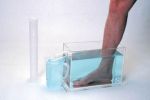
What happens to the water level when you put your foot in the water or say when you get into the bathtub?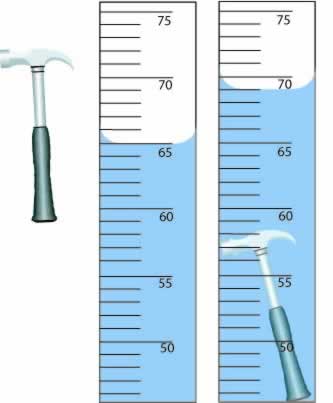
The amount the water rises = the volume of the object in mL. Since 1 mL = 1 cubic cm you can find the volume of the solid object.So you will need to find the volume of your object by dropping the stone into water and measuring how much the level rises. Be Precise.!
Tuesday, August 30, 2011
Do Now: # 4 - Notes on Mass, Volume and Density
Convert the following metric units.
1. convert 4.56 Liters into mL
2. convert .0134 kilometers into millimeters
unit (or AU). How many millimeters is it to the sun?
Once you finish the DO NOW - you should take down the notes on the board about mass, volume and density.
Mass: Measure of the amount of matter in an object. Matter is the stuff that things are made from, protons, neutrons, electrons, etc.
Mass base unit is grams. Mass and weight are different. Weight changes as the force of gravity changes. Mass is always the same. Therefore you would weigh different amounts on the moon but you have the same mass on the moon. Mass is not affected by gravity.
Volume: Measure of the amount of space an object takes up. Either measured by cubic units of length or Liters.
Meniscus = curved line caused by surface tension. You should always measure the bottom of the meniscus.


Density: Is a ratio between an object's mass and its volume. It is the mass per unit volume. It tells us how tightly the matter is packed into an object. The more dense an object the more matter it has per unit volume, ie: the more protons, neutrons and electrons it has.
LAB NOTEBOOKS:
Question: How can I find the density of an unknown substance?
Write down your question, hypothesis, and procedures (bullet points)prior to beginning. You should have a data table prior to beginning as you should anticipate what data you would like to collect. Diagram your set up. Each student needs to have this in their notebook. Clearly label your sections.
Then your job is to find the density of of the unknown solution.
I have assigned your groups by random selection. There will be no switching.
Good Luck.
Hw: Read Chapter 1, section 1 and 4 and do the sections reviews on page 10 and 27.
Procedure: You will be finding the mass and volume of objects to determine their density.
1. gather supplies, triple beam balance and 100mL graduated cylinder
2.zero your balance
3. mass the empty 100 mL graduated cylinder (g.c.) - record data into your data table
4. obtain sample of unknown liquid in your g.c.
5. mass the sample of liquid in the g.c. - record into your data table
6. subtract the mass of empty g.c. from the mass of g.c. + liquid this give you the mass of the ___________.
7. record the volume of liquid you have in your data table
8. calculate the density.
9 repeat the procedure for the second liquid.
Data Table:
1. convert 4.56 Liters into mL
2. convert .0134 kilometers into millimeters
1. .000154 centimeters into kilometers
2. The average distance to the Sun is 149,597,887.5 km. Astronomers call this distance 1 astronomical
unit (or AU). How many millimeters is it to the sun?
Once you finish the DO NOW - you should take down the notes on the board about mass, volume and density.
Mass: Measure of the amount of matter in an object. Matter is the stuff that things are made from, protons, neutrons, electrons, etc.
Mass base unit is grams. Mass and weight are different. Weight changes as the force of gravity changes. Mass is always the same. Therefore you would weigh different amounts on the moon but you have the same mass on the moon. Mass is not affected by gravity.
Volume: Measure of the amount of space an object takes up. Either measured by cubic units of length or Liters.
Meniscus = curved line caused by surface tension. You should always measure the bottom of the meniscus.
Density: Is a ratio between an object's mass and its volume. It is the mass per unit volume. It tells us how tightly the matter is packed into an object. The more dense an object the more matter it has per unit volume, ie: the more protons, neutrons and electrons it has.
LAB NOTEBOOKS:
Question: How can I find the density of an unknown substance?
Write down your question, hypothesis, and procedures (bullet points)prior to beginning. You should have a data table prior to beginning as you should anticipate what data you would like to collect. Diagram your set up. Each student needs to have this in their notebook. Clearly label your sections.
Then your job is to find the density of of the unknown solution.
I have assigned your groups by random selection. There will be no switching.
Good Luck.
Hw: Read Chapter 1, section 1 and 4 and do the sections reviews on page 10 and 27.
Procedure: You will be finding the mass and volume of objects to determine their density.
1. gather supplies, triple beam balance and 100mL graduated cylinder
2.zero your balance
3. mass the empty 100 mL graduated cylinder (g.c.) - record data into your data table
4. obtain sample of unknown liquid in your g.c.
5. mass the sample of liquid in the g.c. - record into your data table
6. subtract the mass of empty g.c. from the mass of g.c. + liquid this give you the mass of the ___________.
7. record the volume of liquid you have in your data table
8. calculate the density.
9 repeat the procedure for the second liquid.
Data Table:
Mass of g.c. | Mass of g.c.+ liquid | Mass of liquid | Volume | density | |
Blue liquid | |||||
Red liquid |
Friday, August 19, 2011
Welcome Back To School- 1st blog assignment
I am very excited to be your science teacher and share with you my joy for scientific inquiry and thinking. There is so much we can learn from the field of science and yet so much to be discovered. Let the journey begin.
Your first blog assignment is to read about and explain any one unit of measurement from the dictionary of measurement and explain it in your post. Some are quite complicated others are quite simple just choose any one of your liking and tell us about it. Maybe you want to choose something you have always heard about but never really knew what it meant. Ex: What is a terabyte? See Below.
You will be graded on grammar and that you properly put your name on your post (follow directions tab at the top of blog - how to post.)
Here is the web address in case you can't link. http://www.unc.edu/~rowlett/units/
tera- (T-)
a metric prefix meaning 1012, or one trillion. The prefix was derived from the Greek word for monster, teras. (Our words "terrible" and "terrific" have this same root.) The three prefixes mega-, giga-, and tera- thus mean something like "huge," "gigantic," and "monstrous," respectively. But also, and apparently by coincidence, the prefix tera- suggests the Greek tetra, meaning 4. This is significant because tera- is the fourth prefix, following kilo-, mega-, and giga-, in the list of SI prefixes for multiples of 1000n. This coincidence was exploited in defining the subsequent prefixes peta-, exa-, zetta-, and yotta-, corresponding to the powers n = 5 through 8 in 1000n, so that they suggest the Greek numbers penta, hexa, hepta, and okta for 5, 6, 7, and 8, respectively.
byte (B)
a unit of information used in computer engineering. Technically the byte is a unit of addressable memory, and its size can vary depending on the machine or the computing language. However, in most contexts the byte is equal to 8 bits (or 1 octet). This means that a byte has 28 = 256 possible states. The unit was named by IBM engineer Werner Buchholz in 1956, and the 8-bit size was popularized starting in 1964 by IBM's System 360, a top-selling mainframe computer. The spelling "byte" is used instead of "bite" in order to avoid confusion with the bit.
Your first blog assignment is to read about and explain any one unit of measurement from the dictionary of measurement and explain it in your post. Some are quite complicated others are quite simple just choose any one of your liking and tell us about it. Maybe you want to choose something you have always heard about but never really knew what it meant. Ex: What is a terabyte? See Below.
You will be graded on grammar and that you properly put your name on your post (follow directions tab at the top of blog - how to post.)
Here is the web address in case you can't link. http://www.unc.edu/~rowlett/units/
Subscribe to:
Posts (Atom)